At 5,895 metres, Kilimanjaro is the world’s tallest free-standing mountain and the highest peak in Africa — and remarkably, it requires no ropes, technical climbing skill, or mountaineering experience to summit. What it does demand is the right route, the right number of days, and honest preparation, since altitude — not fitness — is what turns back most climbers who don’t make it. This guide covers all six official routes side by side, an interactive success rate estimate, and everything else you need to choose with confidence.
Key Distinction — A dormant volcano and UNESCO World Heritage Site (inscribed 1987), protected within Kilimanjaro National Park since 1973. No technical climbing gear required — just the right acclimatization schedule.
01 / Rainforest
Lush, humid montane forest at the mountain’s base, home to black-and-white colobus monkeys and blue monkeys. Every route begins here, though some pass through it faster than others.
02 / Moorland & Heather
Open, rolling heathland dotted with giant lobelias and groundsel plants found nowhere else on Earth. This is where the acclimatization pace of your chosen route starts to matter.
03 / Alpine Desert
A barren, otherworldly landscape of rock and scree with almost no vegetation. Temperatures swing dramatically between scorching days and freezing nights.
04 / Arctic Summit
Glaciers, sub-zero temperatures, and thin air define the final push to Uhuru Peak — the true test of acclimatization over athletic ability.
Every route reaches the same summit. The differences are in scenery, difficulty, accommodation, and your odds of getting there.
| Route | Duration | Accommodation | Difficulty | Success Rate | Best For |
|---|---|---|---|---|---|
| Lemosho | 7–8 Days | Camping | Moderate | 90–93% | Best all-round scenery and acclimatization balance |
| Machame | 6–7 Days | Camping | Moderate–Challenging | 80–85% | Most popular route, Barranco Wall scramble |
| Marangu | 5–6 Days | Hut | Easier Trail, Lower Success | 65–75% | First-timers who want huts over tents |
| Rongai | 6–7 Days | Camping | Moderate | 80–85% | Quietest route, best for the rainy season |
| Umbwe | 6 Days | Camping | Very Challenging | 65% | Experienced, fit, already-acclimatized climbers |
| Northern Circuit | 9 Days | Camping | Moderate (Long) | 95% | Best possible odds and a full loop of the mountain |
Success rates are Komteshane average estimates based on route, duration, and typical acclimatization profiles — individual results vary with fitness, prior altitude experience, and weather.
Kilimanjaro has two prime climbing windows — January to early March, and June to October — separated by the long and short rains. Select a month to see what to expect.
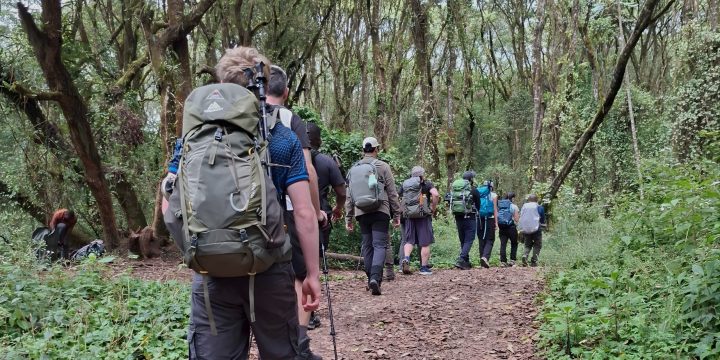
The single biggest factor in reaching the summit isn’t fitness — it’s time. Every extra day on the mountain gives your body more chance to adjust to the thinning air, which is why we steer most first-time climbers toward 7 or 8 day itineraries rather than the fastest options.
Below you’ll find every official route compared side by side, an interactive calculator to estimate your own odds, and a detailed breakdown of each route so you can choose with your eyes open — not just on price.
Answer a few questions about your route, itinerary, and personal fitness to get a science-informed estimate of your Kilimanjaro summit odds — plus a personalized breakdown of what's helping or hurting your chances.
Estimated Summit Odds
This is an educational estimate based on general trends (route profile, acclimatization time, and personal factors) — not a medical or guaranteed prediction. Individual physiology, weather, and guide pacing all affect real outcomes.
Arrive in Moshi, meet your Komteshane guide team, and go through a full gear check and route briefing before an early night ahead of your first trekking day.
Days two onward move steadily through rainforest, moorland, and alpine desert, with your pace and route determining exactly how the days unfold and how well you acclimatize.
Every route converges on the same ritual: a midnight wake-up, a steep, cold ascent by headlamp, and a sunrise arrival at the crater rim before the final walk to Uhuru Peak.
A long descent back through the zones you climbed through, often covering two days' worth of ascent in one, before a celebratory tipping ceremony with your crew at the exit gate.
The exact shape of your climb — duration, scenery, difficulty, and odds of success — depends entirely on which of the six official routes you choose. Compare them all below.
A closer look at each route beyond the comparison table — expand any route below to read the full picture, key stats, and who it suits best.
Widely considered the finest all-round route on the mountain. Starting on the remote western side, Lemosho traverses the entire Shira Plateau before joining the Southern Circuit, delivering the most varied scenery of any route while its long profile gives excellent natural acclimatization. Camping only, and quieter than Machame in the first three days.
Best for: climbers who want the fullest possible experience of the mountain and are willing to pay a premium for it.
Kilimanjaro's most popular route, nicknamed the "Whiskey Route" for its stronger character compared to Marangu. Climbs steeply through rainforest before crossing to Barranco Camp, featuring the famous Barranco Wall scramble. Camping only, with a genuine "climb high, sleep low" profile, especially on the 7-day version.
Best for: climbers who want a strong scenic route with excellent infrastructure and support.
The only route with sleeping huts instead of tents, and the gentlest gradient on the mountain. Nicknamed the "Coca-Cola Route" for its relative ease, though the same path is used for both ascent and descent, offering the least scenic variety of any route. Its faster standard schedule also gives the lowest success rate of the standard routes — we always recommend the 6-day version.
Best for: first-timers who prioritize hut accommodation over camping.
The only route approaching from the north, near the Kenyan border, making it the quietest and most reliable option during the rainier months. Gentle, gradual gradient similar to Marangu, but with full camping. Uniquely, you descend via the Marangu route on the south side rather than retracing your steps — giving genuinely different scenery in each direction.
Best for: climbers who want solitude or are climbing during a wetter month.
The shortest, steepest, and most direct route to Barranco Camp, climbing straight up through dense, quiet forest before joining the same Southern Circuit used by Machame and Lemosho. With no built-in acclimatization day, it has the lowest average success rate of any standard route.
Best for: already-acclimatized, physically fit climbers, or those willing to add an extra rest night at Barranco or Karanga.
Kilimanjaro's newest official route, opened in 2012, and its longest. Shares Lemosho's start at Londorossi Gate before circling the mountain's rarely-seen northern slopes — territory almost no other climbers see — then joins the Southern Circuit at Barafu for the summit. That extra time on the mountain gives it the highest success rate of any standard route.
Best for: climbers who want the complete Kilimanjaro experience and are willing to trade a longer itinerary for the best possible odds.
The Northern Circuit has the highest average success rate at around 95%, thanks to its 9-day itinerary and the most acclimatization time of any route. Lemosho (90%) and the Northern Circuit's cousin routes with 7–8 day profiles come next. Use the calculator above to compare your specific route and duration.
Good general fitness helps, but Kilimanjaro is a non-technical trek, not a climb requiring ropes or specialized skills. Altitude — not muscular strength — is the main obstacle, which is why choosing a longer route matters more than training harder.
Marangu is the gentlest gradient and the only hut-based route, making it popular with first-timers, though its shorter standard itinerary means a lower success rate. Machame or Lemosho on a 7–8 day profile are usually a better balance of comfort and summit odds.
Many climbers use Diamox as a preventative measure against altitude sickness, but it should only be taken after consulting a travel doctor, since it carries side effects and isn't suitable for everyone. It is not a substitute for proper acclimatization time.
Marangu is the only route with dormitory-style sleeping huts; every other route (Machame, Lemosho, Rongai, Umbwe, Northern Circuit) uses full camping with tents. Camping routes generally offer better scenery and a more immersive wilderness experience.
Tipping guides, cooks, and porters is a culturally mandatory part of every climb and isn't included in the upfront trek price. Budget roughly $250 to $350 USD per climber for the full crew, depending on group size and trek length.
Yes, in all Komteshane packages. Park conservation fees, camping or hut fees, rescue fees, and government taxes are fully included and confirmed in writing before any deposit is taken.
January to early March and June to October are the two prime windows, offering the driest trails and clearest summit visibility. April, May, and November see more rain and are generally best avoided if you have flexibility.
Yes. Most technical gear — sleeping bags, trekking poles, gaiters, insulated jackets — can be rented in Moshi or Arusha, which is a common and cost-effective choice for climbers who don't want to invest in cold-weather gear they may not use again.
Yes, and it's one of the most important things to arrange before you travel. Your policy must explicitly cover high-altitude trekking up to at least 6,000 metres and emergency medical evacuation, since standard travel insurance often excludes high-altitude activities.
A comfortable hotel base in Moshi for the night before your climb and a well-earned rest the night after.
Marangu is the only hut-based route; every other route (Machame, Lemosho, Rongai, Umbwe, Northern Circuit) uses full camping with tents, dining tents, and a private cook.