Spanning nearly 14,750 square kilometres of protected wilderness, the Serengeti is not a single tourist stop — it is a dynamic, living world. To experience it properly, you must move away from the crowded routes and the tourist hubs clustered around the main gate. From our base in Marangu, we design journeys that sync with the precise movements of the Great Wildebeest Migration. Our veteran local guides have spent decades tracking these valleys — they know where the predators will be before the predators know it themselves.
UNESCO World Heritage Site — Declared a protected monument of global biodiversity in 1981. Home to the largest unaltered mammal migration on Earth.
01 / Southern Plains
Sweeping volcanic grasslands enriched by alkaline lakes. From December to March, the migration settles here to feed on high-calcium shoots, triggering the legendary calving season. Expect cheetah coalitions and thousands of daily births.
02 / Central Seronera
Rocky granite kopjes and riverine valleys. Seronera’s permanent waters support year-round big cat residency regardless of where the migration sits on the calendar — leopards regularly lounge in the yellow fever acacias.
03 / Western Corridor
A narrow valley tracking westward toward Lake Victoria. In May and June, the migration columns converge on the Grumeti River — home to giant resident Nile crocodiles — producing dense columns and relic riverine forest drama.
04 / Northern Sector
Rolling hills and open woodlands culminating at the Mara River. From July to October, millions of wildebeest face chaotic, high-adrenaline river crossings in search of green pastures — the iconic life-or-death river crossing spectacle.
Select any month to track where the herds are and where we position our camps.
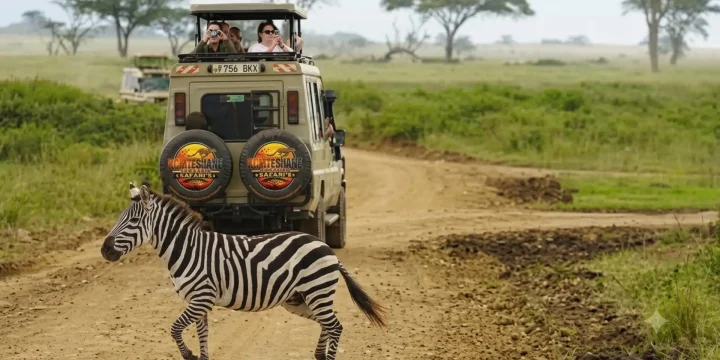
In a park as popular as the Serengeti, poor scheduling leads to rows of minibuses clustered around single predator sightings. We avoid this through rigorous logistics. Our guides coordinate with off-grid field rangers and use decades of localized knowledge to chart dynamic, quieter routes.
Our vehicles observe no rigid mileage curfews. If a lioness is stalking on the riverbank at 6pm, we stay. We also strictly limit high-impact transit lanes, routing through private, uncrowded concession pathways wherever possible. The result: more wildlife, fewer headaches, and a safari that feels genuinely yours rather than borrowed from a brochure.
Fly direct from Kilimanjaro or Arusha Airport by light aircraft into the Serengeti. Land on a savanna airstrip where your private guide and 4x4 await. Transfer to camp and settle in for a sundowner on the plains.
Dawn and dusk game drives in your private vehicle. Track the big cats — leopards hunting on rocky kopjes, lion prides staking out river valleys, cheetah scanning from termite mounds.
Float silently above the plains at first light. Unparalleled bird's-eye perspective of the sweeping savanna, followed by a champagne bush breakfast under an acacia canopy.
A full day following the leading edge of the wildebeest columns. Watch thousands of animals move as one force, surrounded by ever-watchful predators. Bush lunch served in the field.
One last sunrise game drive before your light aircraft returns you to Arusha or Kilimanjaro. Five days that will take years to fully absorb.
The Great Migration is a continuous year-round phenomenon. For the iconic Mara River crossings, aim for July–October in the Northern Serengeti. For the calving and birth season — one of the most dramatic wildlife events on Earth — focus on January–March in the Southern Ndutu sector. Use our season planner above to align your travel window with the herds.
We strongly recommend flying directly via scheduled light aircraft from Kilimanjaro International Airport (JRO) or Arusha Airport into one of the Serengeti's internal airfields — Kogatende for the north, Seronera for the centre, or Ndutu for the south. This takes 45–60 minutes versus an 8–10 hour overland drive on washboard roads. The cost difference is recovered in the extra days of game viewing.
Yes — safaris are exceptionally safe when conducted with professional, experienced guides who understand wildlife behaviour. Our private vehicles provide physical separation from the animals, and we select lodges with strict perimeter security, night patrols, and family suites. We also plan drives around children's energy levels — shorter morning sessions, pool time at midday, and the full drama of the late afternoon drive.
The Serengeti sits in a malaria-endemic region, and precaution is recommended. Consult your travel doctor before departure regarding appropriate prophylaxis. Our partner lodges and camps use comprehensive preventative measures — daily spraying, deep mesh netting on all tent openings, and high-grade repellents for game drives.
Public National Park areas require vehicles to stay on designated tracks and return to camp by 6pm. Private concession areas on the park borders permit off-road tracking, night spotlight drives, and guided walking safaris — all prohibited in the public zones. When we position your camp in a private concession, you gain a fundamentally more flexible and immersive experience.
Yes — all TANAPA national park entrance fees, conservation levies, and vehicle permits are fully included in your quoted price. There are no surprise gate payments on arrival. Our pricing is transparent and confirmed in writing before any deposit is taken.
Classic tented camp in central Serengeti — great value game drive base.
Well-positioned mid-range alternative with reliable game drive access.
Standard camp used on 8-day northern circuit itineraries.
Popular luxury tented camp in the central Serengeti — excellent wildlife position.
Savannah panoramic suites with sweeping plains views — world-class service.
The highest-end Serengeti option — intimate, exclusive, and extraordinary.