Safari Types · The Greatest Show on Earth
The Great Migration is not a single event but a year-round journey — a continuous, clockwise circuit of over two million wildebeest, zebra and gazelle following the rains around the Serengeti ecosystem. Seeing it well is entirely about being in the right sector of the park at the right time of year.
That's where local knowledge is decisive. The herds' position shifts with the rains, and a week's difference or fifty kilometres can be the gap between witnessing a river crossing and missing it. We track the migration continuously and position your camps — often seasonal mobile camps that move with the herds — so you're among the action, not driving hours to reach it.
There are two headline chapters. The calving season (January–March) on the southern plains, when hundreds of thousands of calves are born and predators gather. And the river crossings (July–October) in the north, when the herds mass and plunge across the crocodile-filled Mara. We run dedicated, expertly-timed safaris for both. Expect around $450–$1,100 per person per day, depending on tier and how mobile the camps need to be.
The herds move in one continuous clockwise loop around the Serengeti ecosystem, never stopping, never reversing. Select any month on the wheel below to see where the migration is and what's happening at that point in the circuit.
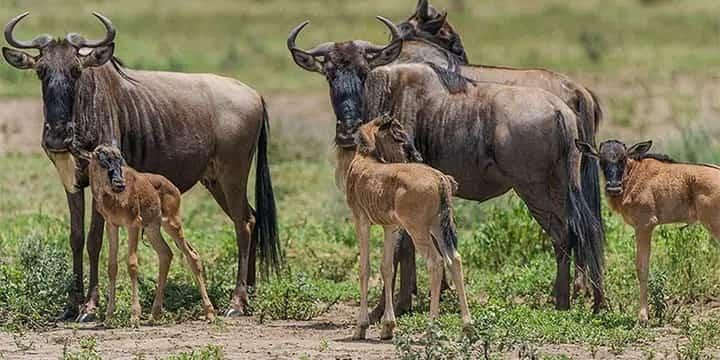
The migration loop closes as herds return to the southern Ndutu plains, setting up for another calving season against beautiful green holiday landscapes.
Our migration safaris are built on four pillars that maximise your chances of witnessing the greatest wildlife spectacle on Earth.
Migration accommodation comes in three distinct styles. Understanding them helps you match your trip to how closely you want to follow the herds.
| Format | What It's Like | Wild Connection |
|---|---|---|
| Seasonal Mobile Camps | Comfortable ensuite mobile camps that move with the herds, placing you minutes from the calving plains or the Mara crossings at the peak season. | 10/10 — Recommended |
| Permanent In-Park Camps | Well-placed permanent camps in the central and northern Serengeti — a fixed base with superb game viewing and quick access to the herds. | 8/10 — Best for facilities |
| Private Migration Camps | Exclusive small camps in prime migration territory — intimate, private and superbly positioned for the season's key events. | 9/10 — Most exclusive |
Positioned for the season's key event — calving in the south (Jan–Mar) or crossings in the north (Jul–Oct). Departs Arusha or Moshi.
| Day | Route & Highlights | Overnight |
|---|---|---|
| Day 01 | Arusha/Moshi → Tarangire. A full day in Tarangire's elephant country as the perfect warm-up, before heading toward the migration sectors of the Serengeti. | Tented camp or similar |
| Day 02 | Ngorongoro → Serengeti. Cross the Ngorongoro highlands and descend into the Serengeti, moving toward the sector where the herds are currently concentrated. | In-park or mobile camp or similar |
| Day 03 | Migration Sector. A full day in the heart of the migration — endless columns of wildebeest and zebra, and the predators that shadow them. | Seasonal mobile camp or similar |
| Day 04 | The Key Event. Newborn calves and intense predator action on the southern plains (Jan–Mar), or the tense wait and thundering plunge of a Mara River crossing (Jul–Oct). | Seasonal mobile camp or similar |
| Day 05 | Serengeti → Home. One last dawn drive among the herds before departing — a light-aircraft flight or scenic drive back to Arusha, or on to Zanzibar. | Ends: Arusha/Moshi or Zanzibar extension |
See how positioning, mobility and cost compare across three migration tiers — from comfortable value to the most exclusive front-row seats.
A private 4x4 Cruiser with charging and cooler box, staying in comfortable ensuite camps positioned near the herds, in the active migration sector for the season.
A private 4x4 with light-aircraft between sectors, staying in seasonal mobile camps that move with the herds, minutes from the calving plains or the Mara crossings.
An exclusive vehicle plus private light-aircraft transfers, staying in private, exclusive migration camps in prime crossing territory, with a dedicated guide and spotter.
River crossings can't be guaranteed — the herds cross when they decide, not on a schedule. Staying multiple nights in the right sector, rather than gambling on a single day, dramatically improves your odds of witnessing one.
Select your season, group size and duration for a baseline migration safari cost estimate. Final quotes are tailored to your exact route and dates.
There are two peak windows. The calving season runs January–March on the southern Ndutu plains, when hundreds of thousands of calves are born and predators gather — daily drama. The Mara River crossings run roughly July–October in the northern Serengeti, when the herds mass and plunge across the river. Both are extraordinary; which suits you depends on the experience you're after.
No honest operator can guarantee a crossing — the herds cross when they decide, not on a schedule. What we can do is maximise your odds: positioning you in the northern crossing sector during peak season, staying multiple nights so you're not gambling on one day, and having guides who read the build-up and hold position. Multi-night stays in the right place dramatically improve your chances.
Calving (Jan–Mar) is about new life and constant predator action on the open southern plains — reliable daily drama, easier to witness. The crossings (Jul–Oct) are about a single explosive spectacle — thousands of animals plunging through a crocodile-filled river — more dramatic but less predictable. Calving is the safer bet for guaranteed action; crossings are the bigger one-off thrill.
Because the herds move continuously with the rains. A fixed lodge might be perfectly placed one month and hours from the action the next. Seasonal mobile camps relocate through the year to stay beside the herds, so you wake up minutes from the migration rather than facing a long drive to reach it. For a migration-focused trip, positioning is everything.
Because timing your trip around calving or the crossings requires exact, current information on where the herds are, generalised estimates only serve as a starting point. For a transparent, line-item breakdown tailored precisely to your travel dates, contact our Arusha operations desk today to build a custom migration safari itinerary.